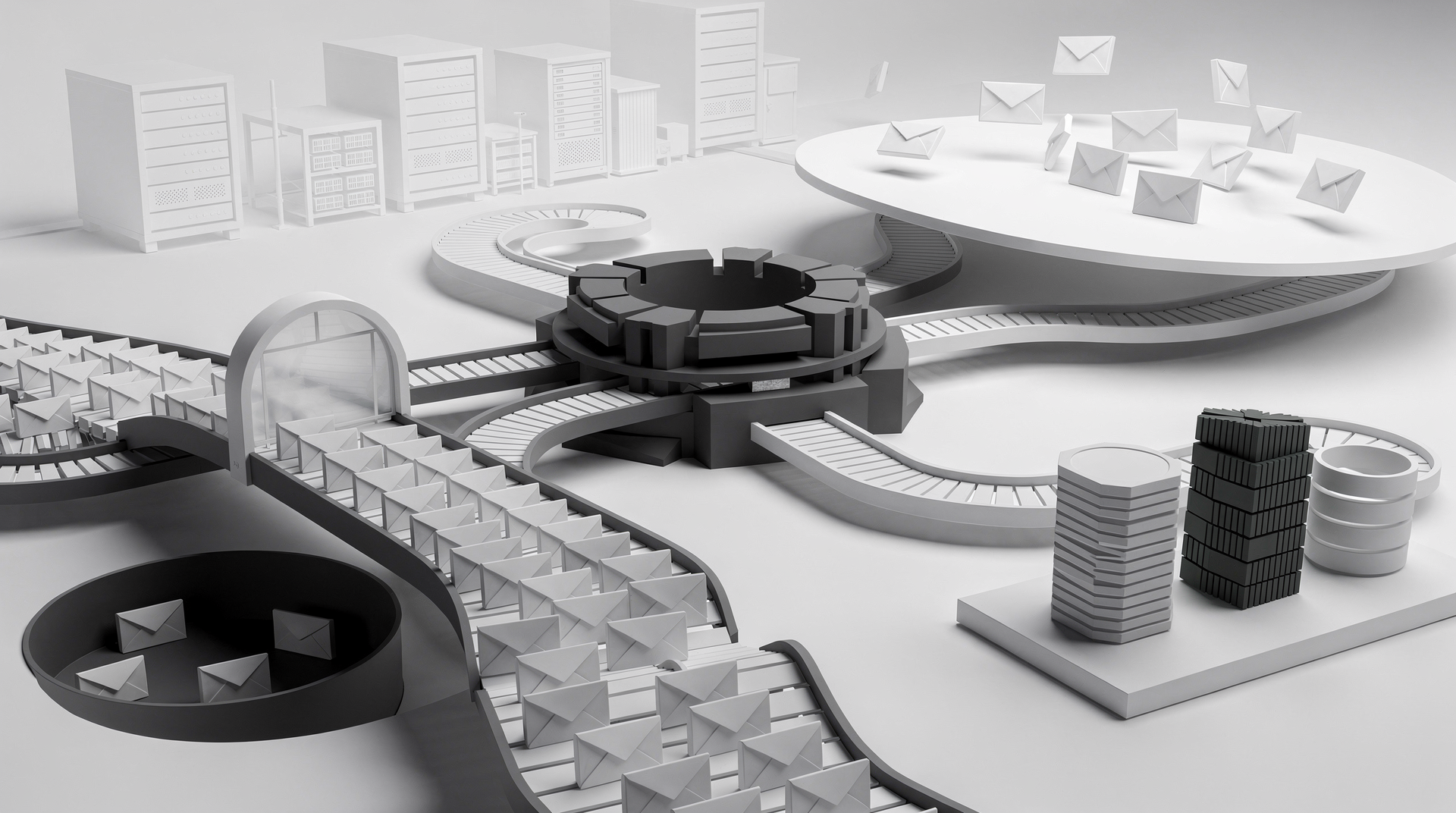
When a flash sale triggers 300,000 order confirmations in four minutes, or a product launch floods your transactional email pipeline, the difference between a reliable system and a total outage is how your architecture absorbs pressure. A flat in-memory queue backed by a single database table will inevitably buckle under burst traffic, causing messages to pile up, workers to crash, and connections to time out. This architecture uses a layered queue stack designed to absorb massive bursts, implement intelligent retries, and guarantee delivery even when input volume spikes tenfold. You will learn how to design decoupled intake buffers, where to enforce backpressure, how to use dead letter queues to prevent blind spots, and which specific metrics signal that your capacity is about to be overwhelmed.
Why a Single Queue Layer Breaks Under Burst Traffic
Most email systems start with a single queue table in PostgreSQL or Redis, a pool of workers, and a third-party SMTP relay. This works at 500 emails per minute but fails at 50,000. The bottleneck is rarely the sending speed; it is the enqueue speed and dequeue contention. When you force a database to handle thousands of row inserts per second while simultaneously managing worker locks, index bloat and vacuum pressure destroy read performance. The expert insight is that database-backed queues are not designed for high-velocity ingestion because the overhead of ACID compliance and index updates creates a "write wall" that slows down your entire application. A micro-example: a SaaS platform using ActiveRecord callbacks for email serialization saw queue latency jump from 2 ms to 900 ms during a Black Friday event because the database was busy serializing templates during the enqueue process rather than just storing the raw payload. Decision rule: Never perform heavy tasks like template rendering or address validation at the enqueue point. Write raw data to a fast intake buffer and move processing to a downstream worker.
Building the Multi-Layer Queue Stack
A resilient email stack uses three distinct layers to isolate failure modes. The first layer is the intake buffer—a high-throughput, append-only store like Redis Streams, Apache Kafka, or Amazon Kinesis. Its only job is to accept incoming messages, assign a sequence ID, and return a success acknowledgment. The second layer is the processing queue, where workers pull from the stream, render templates, and validate metadata. The third layer is the dispatch queue, a rate-limited, provider-aware buffer that respects SMTP throttle limits and API quotas. This separation allows each layer to scale independently. If your intake buffer is backed by Kafka, you can add consumers to handle higher throughput without touching the dispatch logic. A micro-example: an e-commerce site uses Kafka to ingest events, which then triggers a Celery-based processing layer that populates a Redis Sorted Set. This set acts as a "leaky bucket," releasing messages at exactly 85% of their SES sending quota. Decision rule: Always decouple ingestion from dispatch to ensure that a provider-side rate limit does not block your application from accepting new orders.
Implementing Intelligent Backpressure and Rate Limiting
Backpressure is the mechanism that prevents your system from crashing when the output cannot keep up with the input. If your dispatch layer hits a 429 "Too Many Requests" error from your email provider, you must not simply retry immediately. Instead, use an exponential backoff strategy combined with a circuit breaker. If the error rate exceeds a specific threshold—for example, 5% of requests failing over a 60-second window—the circuit breaker trips, pausing the dispatch workers to allow the provider's rate limit to reset. This prevents your system from wasting resources on doomed requests. A micro-example: a marketing platform monitors the `X-RateLimit-Remaining` header from their API provider. When the value drops below 100, the dispatch layer automatically shifts to a lower-priority queue, ensuring that critical transactional emails like password resets still go through while marketing newsletters are throttled. Decision rule: Implement a circuit breaker that monitors provider-specific error codes; if the error rate crosses your defined threshold, stop all outgoing traffic for a cooldown period to prevent account suspension.
Managing Failures with Dead Letter Queues
Even the most robust architecture encounters "poison pills"—messages that cause workers to crash repeatedly due to malformed data or invalid recipient addresses. If these messages remain in the primary queue, they will be retried indefinitely, clogging the pipeline and consuming CPU cycles. A Dead Letter Queue (DLQ) acts as a safety net for these failures. When a message fails after a set number of retries, it is moved to the DLQ for manual inspection or automated analysis. The expert insight here is that a DLQ is not just a trash bin; it is a diagnostic tool. By analyzing the frequency of messages in the DLQ, you can identify patterns, such as a specific template version that triggers a crash or a batch of invalid email addresses from a specific integration. A micro-example: a fintech app noticed a spike in DLQ entries and discovered that a recent API update changed the expected format of the `user_id` field, causing all emails to fail validation. Decision rule: Configure your workers to move any message that fails three consecutive attempts to a DLQ, and set up an alert that triggers when the DLQ size exceeds a predefined threshold.
Monitoring Throughput and Capacity Signals
To prevent an outage, you must monitor the "lag" between the intake buffer and the dispatch layer. If the intake buffer is growing faster than the dispatch layer can process, you are heading toward a system failure. Key metrics to track include consumer group lag, worker utilization, and provider-side latency. Use these metrics to trigger autoscaling events; for instance, if the Kafka consumer lag exceeds 10,000 messages, spin up additional worker nodes. The expert insight is that monitoring the *rate of change* in your queue size is more predictive than monitoring the absolute size. A sudden, vertical spike in queue depth is a signal to throttle incoming traffic or increase resources before the system becomes unresponsive. A micro-example: a logistics company uses a Prometheus dashboard to track the "time-to-send" metric. When this exceeds 30 seconds, the system automatically triggers a horizontal pod autoscaler to add more worker instances. Decision rule: Set up alerts for both queue depth and consumer lag; if the lag is increasing, your infrastructure is under-provisioned, and you must scale your processing layer immediately.
Conclusion
Building a resilient email stack requires moving away from simple database-backed queues toward a layered, decoupled architecture. By separating intake, processing, and dispatch, you gain the ability to scale each component independently and survive massive traffic spikes without losing data. The combination of high-throughput buffers like Kafka, intelligent backpressure mechanisms, and proactive monitoring ensures that your system remains performant under pressure. Remember that the goal is not just to send emails, but to maintain a predictable delivery flow that respects both your infrastructure limits and your email provider's constraints. By implementing these strategies—specifically the use of dead letter queues for poison pills and circuit breakers for rate-limit protection—you transform your email pipeline from a fragile bottleneck into a reliable, scalable asset. Start by decoupling your ingestion layer today, and you will find that your system becomes significantly more resilient to the unpredictable nature of high-volume traffic.